Selena Juarez loves her job.
She is a finance manager at Battery, a full service creative and advertising agency.
Selena was hired in 2019, two months before turning 26.
The assignments she enjoys most are reviewing spreadsheets, reconciling the company’s books, and tracking their budget. She works directly with a number of producers, helping them manage the financial aspects of their TV advertising projects.
Today Selena feels lucky. But when she was 14 and 15 years old, she didn’t feel lucky at all. In fact, the last thing she imagined was becoming a professional of any kind.
Selena was a student at Hamilton High School, in West Los Angeles. She was shy and introverted. She didn’t care for school. She never pushed herself. She was pulling mostly Cs in her freshman and sophomore years. An occasional B. After all, what was the point? She was undocumented, and there was no DACA back then. Selena believed her chances for success were limited.
People at her school were starting to talk about college. But she was under the impression that she wouldn’t have the opportunity to go to college.
Selena says that when she looks back, she realizes that one person after another came into her life at the right time. Kathy, Karina, Deborah and Sandey.
In her sophomore year, it was her best friend, Kathy. That’s when things turned around for her. Kathy introduced her to Communities in Schools of Los Angeles. CISLA, as it’s called, is a drop-out prevention program. CISLA operates throughout the school day and after school on the grounds of 14 schools, including Hamilton High School. Some are high schools, and others are middle and elementary schools.
In those years, Selena was quiet and reserved. She saw herself as an observer. She had little self-confidence. But the other CISLA teens were so nice that she felt she fit right in. She often hung out in the CISLA office. She did homework there. She became heavily involved in CISLA and especially enjoyed a program called “Ladies First.”
She bonded with her CISLA site coordinator, Karina.
One day during class, a friend outed Selena for being undocumented and joked about her status. She was shocked by this painful experience. And she felt betrayed by the boy. Selena immediately ran to the CISLA office, where Karina comforted her.
Then there was Deborah Marcus, who was CISLA’s executive director. Together Deborah and Karina arranged for Selena to have a mentor. A woman named Sandey Kang.
After Selena graduated from high school, Selena and Deborah reconnected.
Selena’s mentor, Sandey, was an agent at Creative Artists Agency, in Hollywood. Little did Selena know how important their relationship would become.
So what was Selena’s journey?
Like so many other young Latinos living in Los Angeles, Selena was born in Mexico. That’s where her parents were married. When Selena was two, her dad brought her to LA and later her mom joined them. In Oaxaca, the education was poor. The financial situation was difficult.
Her dad began working in Los Angeles as a chef. Her mom cleaned houses. A few years later, Selena started elementary school. Her parents had thought about returning to Mexico. But opportunities in Oaxaca were limited. They wanted to provide a better life for Selena, her brother and their sister.
SELENA, TELL ME MORE ABOUT HIGH SCHOOL.
When I started high school, I didn’t care much for school. But I did what I needed to do. People were starting to talk about college. I knew I was undocumented. So I thought I didn’t have the opportunity to go to college. I was shy and introverted. I never stepped out of my comfort zone. I never pushed myself.
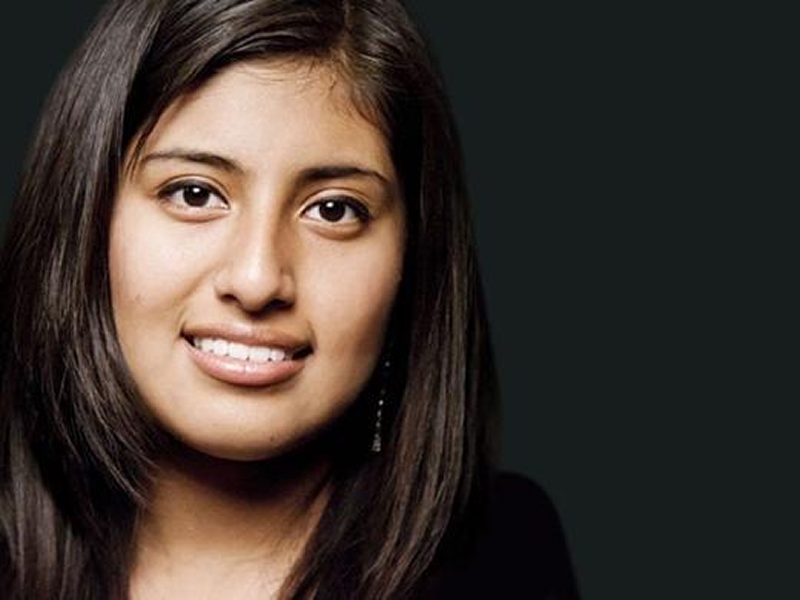
“At first I didn’t care much for high school. But all that changed when I began participating in Communities in Schools of Los Angeles.”
But all that changed when I began participating in our Communities in Schools of Los Angeles after-school program.
A FRIEND INTRODUCED YOU TO COMMUNITIES IN SCHOOLS OF LOS ANGELES. WHAT WAS IT LIKE?
I would go to the CISLA office five days a week. I would do homework there, just hang out. It was very welcoming.
They have different programs going on, like volunteering planting trees. But I felt that CISLA was a safe space no matter what program I participated in.
CISLA MADE A BIG DIFFERENCE IN YOUR LIFE. WHAT WAS ONE OF THE WAYS?
They had a program called “Ladies First.” It was about empowering young women to develop leadership skills. We learned about careers. CISLA had a lot of speakers. We had wellness and fitness programs. Different themes. Speakers came. They told us about their professional roles and how they got there. They were motivating. They encouraged us to explore their fields and encouraged us to do well in school.
YOU LEARNED THAT OTHER STUDENTS IN THE PROGRAM WERE UNDOCUMENTED. HOW DID THAT FEEL?
We formed an informal support group within CISLA. I was comfortable there. My site coordinator shared that she was undocumented growing up too.
KARINA WAS YOUR CISLA SITE COORDINATOR AT HAMILTON HIGH SCHOOL. SHE WAS VERY IMPORTANT TO YOU. HOW DID SHE HELP YOU?
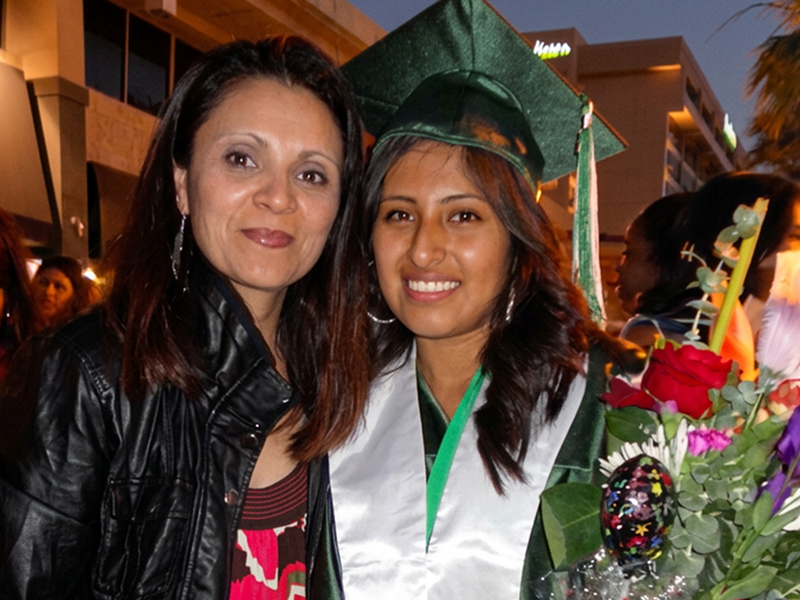
“Karina was my biggest motivator. She is why I changed my life in high school.”
Karina was my biggest motivator. She is why I changed my life while I was in high school.
She definitely motivated me to try harder academically. She encouraged me to be the best version of myself and grow as a student.
I realized that I still had a chance to fix everything—my grades, my attitude, my involvement. I could take all the bad and turn it into positives.
In my junior year I re-took a lot of my classes. I took summer classes. I even enrolled in after-school college classes that West Los Angeles College offered at my high school. They were three hours long and held after school two or three days a week. Just like regular college classes. I remember the computer science class the most. Coding. It was really fun. I got high school credit plus college credit.
HOW DID CISLA HELP PREPARE YOU FOR COLLEGE?
They offered tutoring services and resume services. I did both. They also held SAT classes on the weekends. They provided college campus tours–Cal State LA and UCLA. They held a lot of parent workshops after school, in Spanish. These were about college. How to help your kids transition from high school to college.
And they provided us emotional support. So important.
DURING HIGH SCHOOL YOU HAD A MENTOR. HOW WAS SHE HELPFUL?
CISLA asked me if I would like to have a mentor. I didn’t know what that meant! They had me fill out a form and then matched me with Sandey Kang. She mentored me from my junior year in high school through college and into my career.
Sandey took me for college tours around the city. She helped me with my resume and helped me prepare for interviews. She was always there when I had questions and needed advice. She helped me understand the business world.
Sandey is very supportive and very available. I consider her a great friend.
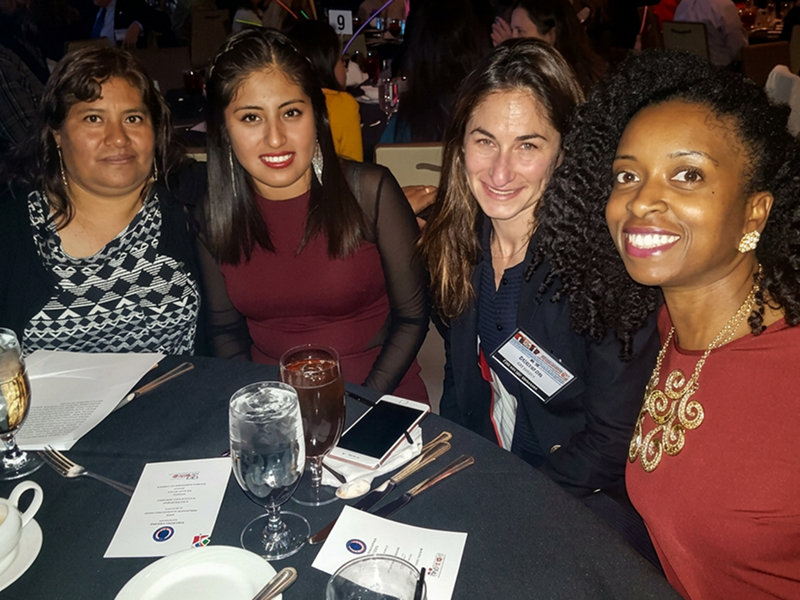
“Don’t give up! And always surround yourself with caring adults.”
YOUR HIGH SCHOOL TRIP TO WASHINGTON, D.C., WAS PAINFUL. WHAT HAPPENED?
My high school offered students a chance to visit Washington, D.C. I wanted to go so badly. I really liked US history and the way government worked.
Little by little my parents had saved money. They gave me the money so I could go. I was really looking forward to the trip.
In DC all of us students finally saw the White House from the outside. We stood in line and waited to get in. When we reached the entrance, we were asked for our Social Security numbers. All I had was my student ID because I was undocumented. They wouldn’t let me in! I called my parents clear across the country and sobbed and sobbed. That impacted me for years to come.
YOU HAD A TERRIBLE EXPERIENCE IN DC. WHAT CONTINUED TO INTEREST YOU REGARDLESS?
The way government worked. We had workshops for a week. We had group discussions with students from around the country. We had the opportunity to go inside the Capitol and see where the Senate meets. We got to meet representatives. I learned about the Federal Dream Act. That’s the one bill I especially resonate with. I wondered, “What are the steps to getting a bill passed?” And afterwards I said to myself, “Wow! That’s how laws are passed.”
WHEN YOU WERE A CHILD YOU KNEW YOU WERE UNDOCUMENTED. DID THIS MAKE YOU UNCOMFORTABLE OR EVEN SCARED?
That day in DC was the first time I saw rejection because of my undocumented status. I always knew I was undocumented, but I didn’t fully understand what that meant. I just thought I couldn’t get on a plane to go visit my grandparents in Mexico. I had to learn the hard way that it meant much more than that.
WHEN YOU WERE A HIGH SCHOOL SENIOR, DACA DIDN’T EXIST. WHAT WERE YOU PLANNING TO DO AFTER GRADUATION?
I didn’t have a vision. I was going with the flow. My mother suggested doing cosmetics. But I resisted. I had no motivation. The idea of college was scary, and besides that, I thought college was for US citizens only.
I thought, maybe I would help my mother with housecleaning or babysitting. I wanted to do more, but didn’t know how.
YOU DECIDED TO GO TO COLLEGE. WHAT WAS THE REASON?
CISLA helped me understand the importance of higher education. They helped me understand what it was like after college. Part of me was always curious and wanted to see if I fit into college life.
YOU WERE ADMITTED TO UC SANTA CRUZ AND OTHER COLLEGES AND UNIVERSITIES. WHY DID YOU CHOOSE CAL STATE LA?
Definitely their political science program. And the commute. I entered as a political science major because learning about government and politics was fascinating to me, especially after visiting DC in high school. It really inspired me to pursue a degree in political science.
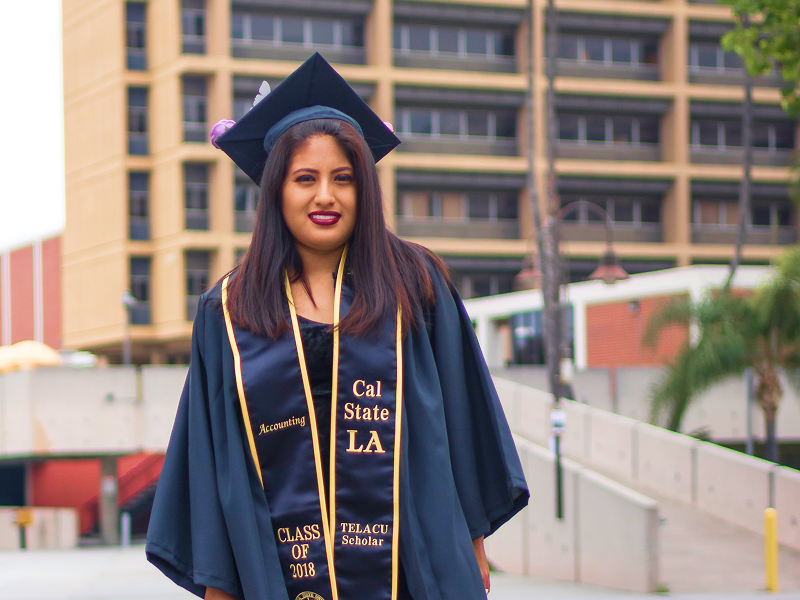
“Cal State LA gave me the opportunity to grow. I enjoyed every second of school and still miss it.”
HOW WAS THE COMMUTE TO CAL STATE LA?
For my first six months I commuted by bus. Two hours to get there and two hours to come back. It was tough, really tough.
WHEN DID YOU LEARN ABOUT DACA (DEFERRED ACTION FOR CHILDHOOD ARRIVALS)?
DACA was announced two weeks before I graduated from high school, in 2012. It was the perfect timing for me. That’s what motivated me to continue. When I learned about DACA, I realized that I would be able to work and fund my college education. I would be able to get a driver’s license.
YOU APPLIED FOR DACA. WHAT HAPPENED?
I applied three months after graduation.
It was a brand new program; nobody knew what was going on. We had to gather material. I had different sources who helped me. I was told “Just gather all the information you can.” It took a long time.
CHIRLA was especially helpful. (“CHIRLA” is short for Coalition of Humane Immigrant Rights Los Angeles.) They helped me prepare and complete paperwork for the government. They provided legal counsel for free or a tiny fee. They reviewed my documents and made corrections. Very thorough.
I was competing with others who were applying. At least half a million applied nationwide. Some didn’t apply because they were scared.
YOU DIDN’T KNOW WHETHER YOU WOULD GET DACA OR NOT.
I felt lucky because they had such strict requirements and I was able to meet them and to take advantage of the program. I continued my plans to go to school.
AT THE END OF YOUR FIRST SEMESTER YOU LEARNED THAT YOU HAD RECEIVED DACA STATUS. HOW DID YOU MANAGE BEFORE THAT?
I received scholarships. I was able to fund myself for the first six months of college.
HOW DID YOUR DACA STATUS HELP YOU?
For one thing, it motivated me to learn how to drive. I got a very old car and commuted.
Once I was registered as a DACA recipient, I was ready to go. I could work and fund my college education.
Before DACA I didn’t see myself being successful. But today I am.
YOU BEGAN AS A POLITICAL SCIENCE MAJOR BUT EVENTUALLY CHANGED YOUR MAJOR.
Yes, I started as a political science major. But I began to fear that I might not be able to find a job, even with my DACA status. I switched from political science to business administration by the end of my second semester.
WHAT WAS IT LIKE TO BE A BUSINESS ADMINISTRATION MAJOR?
I began taking business classes. I really enjoyed my accounting classes. At one point I took a marketing class. I decided I liked both accounting and marketing. In my senior year I selected marketing as my primary focus. I studied marketing analytics. I studied marketing research, both quantitative and qualitative. I studied social media marketing, which was up and coming.
YOU ENJOYED GOING TO COLLEGE. WHY?
Cal State LA gave me the opportunity to grow. I enjoyed every second of school and still miss it.
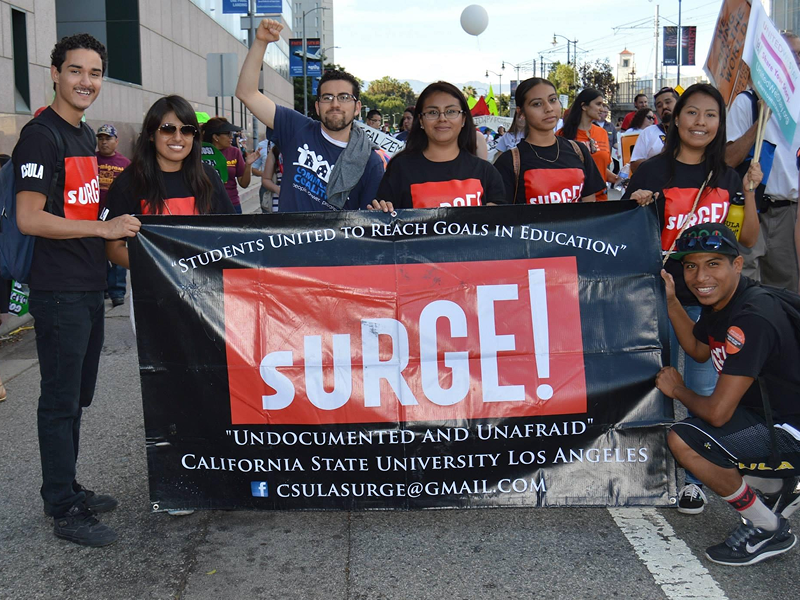
“I helped provide services to undocumented students as a SURGE member. So gratifying.”
AT CAL STATE LA YOU HELPED UNDOCUMENTED STUDENTS. WHAT DID YOU DO? <h/5>
There was an organization on campus called S.U.R.G.E. Short for Students United To Reach Goals in Education. We helped bring resources to students, such as scholarships, information on DACA and financial aid. We made presentations to high school students who were thinking of pursuing higher education, as well as parents.
We provided “Know Your Rights” workshops. We also brought professionals who were more knowledgeable about DACA to guide our members on applying and to answer questions.
All S.U.R.G.E.’s money was raised through personal donations from individuals who supported our cause, bake sales on campus, and other fundraising events throughout the school year.
IT TOOK YOU SIX YEARS TO GRADUATE FROM CAL STATE LA. WHY?
For one thing, I changed my major. Also, I used to work, and prioritized work. A lot of people took even longer.
WHEN YOU BEGAN COLLEGE, YOU WERE AFRAID OF THE FUTURE. HOW DID YOU BECOME MORE COMFORTABLE?
At first I asked myself what I would do with my life. But during my second semester, I reconnected with Deborah Marcus, the CISLA executive director. She hired me to work for Communities in Schools of Los Angeles in their headquarters. I worked 20 hours a week as their administrative assistant for nearly three years. I learned accounting, development and operations.
The CISLA office was located inside the Creative Artists Agency in Century City. I never worked directly for CAA. It was more of a networking opportunity. In the elevator, for example. CAA invited CISLA to lunches on the floor. I was able to speak to many people. I was in my “networking era.”
My mentor, Sandey Kang, was working at CAA (Creative Artists Agency) at the time. She was a great supporter and introduced me to so many people in the building.
I learned about the whole talent world. I was just fascinated. At that point I decided to pursue business.
AS A CHILD YOU WERE QUIET. BUT YOU’RE NOT QUIET ANYMORE. WHAT HAPPENED?
When I began college, I told myself that I wanted to put myself out there. Working for CISLA, I learned how to be talkative, a social butterfly. It helped me evolve into a person who isn’t afraid to speak to somebody.
WHAT IS YOUR ADVICE FOR YOUNG PEOPLE?
Don’t give up. And always surround yourself with caring adults. They will be your biggest champions. They will help you get to where you want to be, and beyond. Never forget them. Nurture those relationships and turn them into friendships.
TODAY YOU VOLUNTEER FOR COMMUNITIES IN SCHOOLS OF LOS ANGELES. THE VERY ORGANIZATION THAT HELPED YOU WHEN YOU WERE A TEENAGER.
Yes, I am on their board. We discuss how the organization is doing generally and financially. I am a voting member, so I help make decisions.
I am part of the Finance Committee. Formerly I was chair of the Audit Committee. It’s wonderful. I am helping CISLA, and at the same time, I am learning what finances look like in the nonprofit world.
YOU ALSO VOLUNTEER FOR THE NATIONAL ORGANIZATION, COMMUNITIES IN SCHOOLS. WHAT DO YOU DO AS A VOLUNTEER?
Our national office works with all the other offices. I am part of the alumni program. We work as a group. We see how everybody’s doing across the country. We’re there to share our experience as former students of Communities in Schools. We provide feedback on how they can best support students. We share our thoughts about how they can improve the program, and provide services for more students.
We talk to donors and staff. We get invited to their town halls. I’ve been going to their town halls every year for the last four years. To Dallas, Fort Worth, Indianapolis, and Detroit.
My goal is to give back to our Communities in Schools community.